



November 25, 2026
By Linda M. Chatwin, Esq., RAC, lead regulatory and quality consultant, Emergo by UL
The transition from the Quality System Inspection Technique (QSIT) to the risk-based process under Compliance Program 7382.850 represents a significant change in how the U.S. Food and Drug Administration (FDA) conducts medical device manufacturer inspections. The shift moves inspections away from a structured, subsystem-based approach toward a fluid, risk-driven and process-integrated evaluation.
From four rigid subsystems to six fluid QMS areas
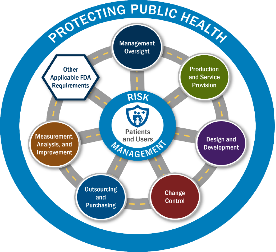
Previously, investigators used a structured, top-down approach focusing on four primary subsystems. Now, inspections are structured around six integrated quality management system (QMS) areas and four other applicable FDA requirements (OAFRs). Investigators navigate the entire life cycle of a device, recognizing that a failure in one area may be linked to processes in another.
| Old QSIT framework | New risk-based framework |
| Four subsystems: • Management Controls • CAPA • Design Controls • Production and Process Controls | Six QMS areas: • Management Oversight • Design and Development • Production and Service Provision • Outsourcing and Purchasing • Change Control • Measurement, Analysis and Improvement |
| Satellites: • MDR, Recalls, Tracking | Four OAFRs: • Medical Device Reporting (MDR) • Corrections and Removals • Medical Device Tracking • Unique Device Identification (UDI) |
Risk management files as the inspection road map
Under the QSIT approach, risk analysis was reviewed primarily inside Design Controls or Corrective and Preventive Actions (CAPA). With the new process, the risk management file created under ISO 14971 becomes the inspection’s navigation road map. Investigators prioritize their focus and choose sample sizes based on the specific patient- and user-safety risks identified in the manufacturer’s documentation, then map risk controls through complaint handling, the CAPA process, and design and process controls.
Furthermore, in the new inspection process, the FDA has explicit authority to review internal quality audits, supplier audit reports and management review minutes and actions to determine whether risks are properly identified and managed through the risk management system, with greater visibility into executive accountability and systemic correction.
Implementation of two inspection models
The new approach replaces the historical Level 1/Level 2 QSIT tiers with two distinct inspection models:
- Model 1 (Routine/Surveillance) – Used for standard surveillance, for-cause and postmarket inspections. Investigators are instructed to evaluate a minimum of one element from each of the six QMS areas, selected based on product risk.
- Model 2 (Comprehensive/Baseline) – Used for first-time inspections and premarket approval (PMA) inspections. This model requires deep-dive sampling and evaluation across 23 specified sampling elements within the six areas. Attachment A of the compliance program identifies the purpose, elements and requirements of each QMS area and OAFR.
Investigators use critical thinking to identify product risks that could adversely affect patients or users. This includes becoming familiar with manufacturers’ roles, products and processes to understand applicable requirements. Based on a review of the risk documentation and using critical thinking, the investigator selects the elements and evaluates related requirements. This is not performed in a specific order. The following graphic from the compliance program depicts the central focus on risk management, tied to the six QMS areas and the OAFRs, indicating that all will be reviewed for appropriate risk considerations to protect public health.
What FDA inspections have found: QSIT vs. QMSR
As manufacturers have observed over the years with QSIT inspections, CAPA findings were most prevalent, followed by complaint handling and design controls. Findings were often cross-referenced to other QMS areas.
Among the early findings from Quality Management System Regulation (QMSR) inspections, risk management was the most frequently cited observation. Speaking at the Food and Drug Law Institute (FDLI) Annual Conference on May 6, 2026, Keisha Thomas, director of Compliance and Quality in the FDA Center for Devices and Radiological Health (CDRH) Office of Product Evaluation and Quality, said the FDA had completed “just north of 100” QMSR inspections. For FDA Forms 483 issued from February to mid-April 2026, risk management ranked first, followed by outsourcing and purchasing, complaint handling and feedback, unique device identification (UDI) and corrective action. Information on the FDA Data Dashboard does not currently distinguish between QSIT and QMSR findings. However, published FDA Forms 483 can be viewed individually. These early findings provide insight into how the FDA is applying QMSR inspection techniques across medical device companies.
Comparison of QSIT and QMSR findings
| Theme | Under QSIT | Under the QMSR |
| Most prominent findings | CAPA (820.100), complaint handling (820.198) and design controls (820.30). | Risk management first, then outsourcing and purchasing, complaint handling, UDI and corrective action. |
| How findings are cited | By Code of Federal Regulations (CFR) section, within the four QSIT subsystems. | By ISO 13485:2016 clause, organized around the six QMS areas and referencing the firm's own documentation. |
| Scope of a finding | Often a procedural or record gap. | May involve multiple QMS processes, linking risk management to complaints, CAPA and suppliers. |
| Continuity | Long-running repeat deficiencies. | Early analyses found deficiencies similar to historical Quality System Regulation (QSR) findings, framed differently. |
Concluding remarks
To be prepared for a QMSR inspection, it is important that the risk management process be connected to other processes within the QMS. Confirm that complaint trends, CAPA, supplier controls and change decisions trace back to the manufacturer’s risk documentation. CAPAs must be verified for effectiveness against the root causes identified.
Review supplier and outsourcing controls to verify that they are monitored and up to date, and that internal audit, supplier audit and management review records are complete with follow-through on findings. And again, tie identified actions into the risk management system to show that risks are properly mitigated and risk controls are evaluated for effectiveness.
Our final feature in this series will discuss how QMSR inspections differ from Medical Device Single Audit Program (MDSAP) audits and the Essential Principles of Safety and Performance. For more on the QMSR, read Part 1 on the FDA QMSR and its impact and Part 2 on the new inspection program.



Request more information from our specialists
Thanks for your interest in our products and services. Let's collect some information so we can connect you with the right person.